He had some difficulty in getting the shikaris to cut the path, and it was only by his being able to get about on the slope safely with ice claws on his boots that he kept them at the work. Our other pair of claws had been stolen at Arundu, but I could not have worn them as they were too small for my boots.
Our Khansamah (cook) was the next to come down. I was rather nervous about him, as he is of a timid nature and not used to mountains, and on the march had had to be helped at very easy places, Down rocks etc. However, a shikari brought him safely down to where I was.
It was a very slow job getting the coolies down. Neve had great trouble with them, 12 of them refusing to come further, and were sent back.
Of the rest, one man came down with a small load, the rest, with or without loads, were helped down by the shikaris. The heavier loads, the shikaris brought down themselves.
When the rope wasn’t wanted any more, I was starting to go on down the slope - now not so steep - but the shikaris would not let me till another man came up to help me, I holding on to his girdle. He slipped and I had to hold him up.
The reason they were so careful about me was because had anything happened to either Neve or me they would have been punished - so they told me afterwards..
It was two hours between the time that the first man came through the tunnel and when we were all together again at the bottom of the steep slope, 200 feet or so below the cornice.
Before staring on again, we had a tope out to which the old guide, 2 shikaris and I linked, and soon after, as evidently there were crevasses about, the other 3 shikaris linked onto us, and Neve made the coolies rope together in two parties.
There was first a flat bit of going, then a descent of 200 feet then an easy slope. We were going parallel to the direction of the valley, having ice precipices and ice falls on our left above the glacier which was several hundred feet below us, and on our right, snow-covered ice slopes.
Before we had got a mile from the top of the pass and had come down about 600 feet, the bergshrund (“yawning” wrote Neve, “15 to 30 feet wide”) closed round in front of us.
Neve and the shikaris then went on to reconnoitre, going a short way to the right, where there was an ice fall, and then the right, where there was another. Then came to a crevasse which was still bridged by snow. Neve was roped and tried to cross, but the bridge gave way. Beyond the crevasse, the slopes down to the main glacier were nothing but ice falls and crevasses, and looked hopeless.
Monday, June 1, 2009

Monday, May 25, 2009
Fourteen
Anyhow, we couldn’t cross this first crevasse - or rather bergshound, and when the shikaris came back after about 20 minutes and said there was no road, all the coolies except one began to cry, rubbing their knuckles in their eyes - a funny sight.
The shikaris then went with Neve back a little to the left, where there seemed to be a possible way across the bergshrund downward. Meanwhile I went to forage for something to eat in the kilter, and got a hunk of bread, and one for Neve. I then went to see what the shikaris were doing when I met the coolie who hadn’t wept coming up, and he called out to the coolies, who began at once to pick up their loads.
Wondering if a route had been found, I went on, but almost at directly met Neve who said “we must go back.”
The coolies had already started, so we followed and got hold of the tiffin basket and secured a slice of bread and jam each, and one for the Khansamah. Neve was pretty well done, having had nothing since Choti Haziri. at 6am, except 2 Kola biscuits, and had been hard at it all day and it was now nearly 5 o’clock.
It was impossible for the coolies to camp out on the snow without fire or shelter, or some further exploring might have been done. But considering all the crevasses were open, and there were several hundred feet to get down to the glacier, and then 3 or 4 miles across the glacier to the camping place at Haigatum - at the side of the Hispar -I think the chances were against our getting through.
There was nothing for it but to go back, and we started up the slopes. When we reached the steep slope, Neve and I roped up with the guide, the Khansamah being looked after by a shikari. This time I got both hands to by khud stick (Alpine stick), so was all right. On getting back through the cornice there was a general congratulation between the shikaris, who also shook our hands, evidently very delighted to have brought us safely back. One shikari was especially moved, and knelt down by Neve and shaking his hand and almost crying, saying he would have cut his own throat if we hadn’t got back all right. The coolies too embraced one another as they got through the tunnel out on to safe ground.
We descended to the rocks where the old shelters were, and there were further congratulations.
It was now about 6 o’clock, and the men said the snow would be too soft for us to get back to Stiatbu Branza, so it was decided to stay where we were for the night. There was no room to pitch a tent, so Neve and I put our beds under a rock. A there was no fire wood, the coolies broke up two of the load kilters for the cook to make a fire with, and we dined off mulligatawny soup, Irish stew and cocoa.
Considering it was about 17,000 ft, it wasn’t very cold. The coolies lay about on the rocks and covered themselves up with the tent flies. They groaned a good deal during the night, but that was more or less to their dinner of raw meal soaked in water. It was a lovely moon-lit night, and I lay awake a good deal of the night looking across and down the long vale of snow and at the range of broken peaks on the other side, all draped in shining white. I may never see such a scene again.
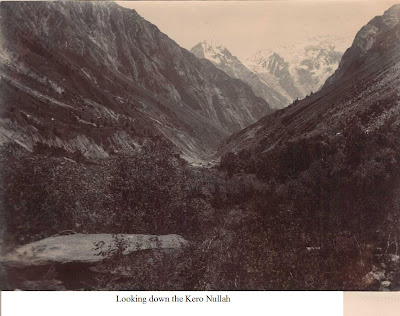
Early next morning we were up and off, the snow being crisp and hard, down the valley to Stiatbu Branza. It was a cloudless morning, and the view down the Kero glacier and valley magnificent. Then on across the two side glaciers, finding a better route through the crevasses that when we came up, to Ding Branza, arriving there at 10.15 (2½ hrs and about 5 miles from the Nushik La. Here we rigged up an umbrella on a pole and sheltered under it waiting for breakfast. Left at 11.30, crossed the Kero Glacier and reached Kutche Branza at 2.10.
Not having had a wash since Wednesday morning, I essayed a bathe in the little lake. Neve sketched the while. When the coolies arrived, we went on another hour to Harimuch, where some trees and shrubs are, where we breakfasted on the way up, and there camped.
The shikaris then went with Neve back a little to the left, where there seemed to be a possible way across the bergshrund downward. Meanwhile I went to forage for something to eat in the kilter, and got a hunk of bread, and one for Neve. I then went to see what the shikaris were doing when I met the coolie who hadn’t wept coming up, and he called out to the coolies, who began at once to pick up their loads.
Wondering if a route had been found, I went on, but almost at directly met Neve who said “we must go back.”
The coolies had already started, so we followed and got hold of the tiffin basket and secured a slice of bread and jam each, and one for the Khansamah. Neve was pretty well done, having had nothing since Choti Haziri. at 6am, except 2 Kola biscuits, and had been hard at it all day and it was now nearly 5 o’clock.
It was impossible for the coolies to camp out on the snow without fire or shelter, or some further exploring might have been done. But considering all the crevasses were open, and there were several hundred feet to get down to the glacier, and then 3 or 4 miles across the glacier to the camping place at Haigatum - at the side of the Hispar -I think the chances were against our getting through.
There was nothing for it but to go back, and we started up the slopes. When we reached the steep slope, Neve and I roped up with the guide, the Khansamah being looked after by a shikari. This time I got both hands to by khud stick (Alpine stick), so was all right. On getting back through the cornice there was a general congratulation between the shikaris, who also shook our hands, evidently very delighted to have brought us safely back. One shikari was especially moved, and knelt down by Neve and shaking his hand and almost crying, saying he would have cut his own throat if we hadn’t got back all right. The coolies too embraced one another as they got through the tunnel out on to safe ground.
We descended to the rocks where the old shelters were, and there were further congratulations.
It was now about 6 o’clock, and the men said the snow would be too soft for us to get back to Stiatbu Branza, so it was decided to stay where we were for the night. There was no room to pitch a tent, so Neve and I put our beds under a rock. A there was no fire wood, the coolies broke up two of the load kilters for the cook to make a fire with, and we dined off mulligatawny soup, Irish stew and cocoa.
Considering it was about 17,000 ft, it wasn’t very cold. The coolies lay about on the rocks and covered themselves up with the tent flies. They groaned a good deal during the night, but that was more or less to their dinner of raw meal soaked in water. It was a lovely moon-lit night, and I lay awake a good deal of the night looking across and down the long vale of snow and at the range of broken peaks on the other side, all draped in shining white. I may never see such a scene again.
Early next morning we were up and off, the snow being crisp and hard, down the valley to Stiatbu Branza. It was a cloudless morning, and the view down the Kero glacier and valley magnificent. Then on across the two side glaciers, finding a better route through the crevasses that when we came up, to Ding Branza, arriving there at 10.15 (2½ hrs and about 5 miles from the Nushik La. Here we rigged up an umbrella on a pole and sheltered under it waiting for breakfast. Left at 11.30, crossed the Kero Glacier and reached Kutche Branza at 2.10.
Not having had a wash since Wednesday morning, I essayed a bathe in the little lake. Neve sketched the while. When the coolies arrived, we went on another hour to Harimuch, where some trees and shrubs are, where we breakfasted on the way up, and there camped.

Sunday, May 17, 2009
Fifteen
Saturday 7th September. Made an early start and reached Domok, where we found the fires of the wazir’s party smouldering, so Neve sent two shikaris after him to let him know we were coming back.
He got such an unfriendly reception at Arundo that he did not wait there but went on. The people were angry with him for taking their men to go over the pass.
(Neve writes: “he said...all the village folk came out to abuse him, the women tearing their hair and their clothes and throwing dust in the air, exclaiming that he had sent their men folk to destruction. He says the pass was well-known in former days, and that the time to go is when the mulberries ripen, late in June, when all the crevasses are covered in.”)
We got back to our old camping place at Arundo. The mountain slopes had a still more autumnal look than when we went up. As we came to the village, men, women and children came from the fields and embraced the shikaris in their fashion, putting their heads near one another, first on one side and then on the other, touching the tips of fingers with the right hand and salaaming with the left. Then more of the women (and an awfully ugly lot they were) came out of the village to give a like welcome. And I suppose the same performance was gone through when the coolies arrived.
Neve and I sat on a bank at our camping place and a crowd of men came and round discussing the situation. It is certainly a good job for the people that we were turned back, for any how they would not know what had become of their friends for a week longer, and as a matter of fact, though we had a perfect day on the pass and the day after, the weather has been so thick (this written four days later) since then, the men would not have been able to get back over the Nuskil La and could not have got home for several weeks, going round by Gilghit and the Indus Valley.
Dák Bungalow, Shigar,
Thurs 12th Sept., 1895, Baltistan.
My Dear Arthur (his youngest brother).
This being likely to be a short letter, more of a length to suit your taste, I will address it to you. I must assume you have read my letter to Albert (another brother), which probably you may not have done, though you may get it on from Stafford (the eldest brother) later...
Having arrived back at Arundo on Saturday 7th, we rested there on Sunday after our labours of the week.
One of the shikaris, who had made himself very useful to us on our way up to the Nuskil La and back, still remained faithful and came on with us in the capacity of khitmutgar. He had put off his garments, in which he looked like a brigand, combed his long hair and appeared as a respectable coolie.
The 5 shikaris who came up with us to the pass were splendid fellows, very different from the coolies who cried when they thought they were in difficulties.
Neve had a few patients on Sunday, but Arundo seems to be a more healthy place than some. The people have to be hardy to stand the winters they get here. They get 12 feet of snow in the winter, and the shikaris have to go out shooting to get food. So they have to learn a lot of mountain craft.
On Monday morning early we started off down the valley and a 4 hours march brought us to Doko, where we camped on the way up. Here we found our friend the Wazir of Shigar seated under a big walnut tree, surrounded by a concourse of lambadarss and people and his servant with the cherry-coloured breeches, who is as like Wood (our old butler) like two peas..
It had been raining most of the morning, so we were glad of a fire to dry ourselves. We had breakfast, and when the coolies arrived, paid them off and got a fresh lot, and went on to Chu Trun, where the hot springs are. However, the natives were making great use of them this time, so I could not get a bathe.
The next morning Neve did some doctoring, and did some 20 operations for trichinosis, a complaint of the eyes, the eye lashes growing inward (due to smoke, and rubbing the eyes. After a few years, the eyes become blind). Neve had an average of about 10 such cases in every village; 25 per cent of the people have complaints of the eyes of some sort.
We left at midday and came on about 6 miles to below the junction of our river, the Brasha, with the Braldo, which together form the Shigar River, where we found a goatskin raft prepared for us, on which we were to go the rest of the way down the Shigar.
It was a small raft, with 2 men to work it. Neve and I and our cook, and the Wazir took our seats on board, then shoved off and away we went.
He got such an unfriendly reception at Arundo that he did not wait there but went on. The people were angry with him for taking their men to go over the pass.
(Neve writes: “he said...all the village folk came out to abuse him, the women tearing their hair and their clothes and throwing dust in the air, exclaiming that he had sent their men folk to destruction. He says the pass was well-known in former days, and that the time to go is when the mulberries ripen, late in June, when all the crevasses are covered in.”)
We got back to our old camping place at Arundo. The mountain slopes had a still more autumnal look than when we went up. As we came to the village, men, women and children came from the fields and embraced the shikaris in their fashion, putting their heads near one another, first on one side and then on the other, touching the tips of fingers with the right hand and salaaming with the left. Then more of the women (and an awfully ugly lot they were) came out of the village to give a like welcome. And I suppose the same performance was gone through when the coolies arrived.
Neve and I sat on a bank at our camping place and a crowd of men came and round discussing the situation. It is certainly a good job for the people that we were turned back, for any how they would not know what had become of their friends for a week longer, and as a matter of fact, though we had a perfect day on the pass and the day after, the weather has been so thick (this written four days later) since then, the men would not have been able to get back over the Nuskil La and could not have got home for several weeks, going round by Gilghit and the Indus Valley.
Dák Bungalow, Shigar,
Thurs 12th Sept., 1895, Baltistan.
My Dear Arthur (his youngest brother).
This being likely to be a short letter, more of a length to suit your taste, I will address it to you. I must assume you have read my letter to Albert (another brother), which probably you may not have done, though you may get it on from Stafford (the eldest brother) later...
Having arrived back at Arundo on Saturday 7th, we rested there on Sunday after our labours of the week.
One of the shikaris, who had made himself very useful to us on our way up to the Nuskil La and back, still remained faithful and came on with us in the capacity of khitmutgar. He had put off his garments, in which he looked like a brigand, combed his long hair and appeared as a respectable coolie.
The 5 shikaris who came up with us to the pass were splendid fellows, very different from the coolies who cried when they thought they were in difficulties.
Neve had a few patients on Sunday, but Arundo seems to be a more healthy place than some. The people have to be hardy to stand the winters they get here. They get 12 feet of snow in the winter, and the shikaris have to go out shooting to get food. So they have to learn a lot of mountain craft.
On Monday morning early we started off down the valley and a 4 hours march brought us to Doko, where we camped on the way up. Here we found our friend the Wazir of Shigar seated under a big walnut tree, surrounded by a concourse of lambadarss and people and his servant with the cherry-coloured breeches, who is as like Wood (our old butler) like two peas..
It had been raining most of the morning, so we were glad of a fire to dry ourselves. We had breakfast, and when the coolies arrived, paid them off and got a fresh lot, and went on to Chu Trun, where the hot springs are. However, the natives were making great use of them this time, so I could not get a bathe.
The next morning Neve did some doctoring, and did some 20 operations for trichinosis, a complaint of the eyes, the eye lashes growing inward (due to smoke, and rubbing the eyes. After a few years, the eyes become blind). Neve had an average of about 10 such cases in every village; 25 per cent of the people have complaints of the eyes of some sort.
We left at midday and came on about 6 miles to below the junction of our river, the Brasha, with the Braldo, which together form the Shigar River, where we found a goatskin raft prepared for us, on which we were to go the rest of the way down the Shigar.
It was a small raft, with 2 men to work it. Neve and I and our cook, and the Wazir took our seats on board, then shoved off and away we went.
Monday, April 27, 2009
Sixteen
The river the whole 30 miles down to Shigar runs in a sandy plain, and keeps on breaking into branches and joining up again. There are many rapids, especially where the branches join, down which the raft shot at a splendid rate.
After about 10 minutes’ run, we had to land as we got into shallow water, and had to walk some distance, then a run of 25 minutes, when we had to land again for repairs. The next run was an exciting one, as there were several shallow rapids over which the raft could hardly get, the skins grinding along the stony bottom, and at one place there was a sharp corner where we nearly got stranded on a bank. Besides this, there was a good deal of rough water and we shipped some seas. One skin had gone from under, and the rest were knocked about and lost air, so we had to land for them to be blown up again, and everything made ship-shape..
The cook had got hold of some jolly red apples and grapes, which we sat and munched on the way.
We finally landed near a village, Gulabpore by name, where we were to camp - to which place we walked up - it was situated as usual on a fan of moraine, chose an orchard for our camp and had a fire lighted to dry ourselves by.
The lumadar brought us a basket of sort of nectarines. There was soon a crowd of peope round with bad eyes etc to whom Neve attended till darkness and rain stopped him.
The next morning was lovely, 3 near snow peaks of 20,000 ft and over, being splendidily lit up by the morning sun, all the lower mountains on both sides of the valley all the way down being sprinkled with fresh fallen snow. There was a mistiness, like an English September morning.
We had a jolly walk through the fields and water meadows to the river, where we found our raft, which had been enlarged during the night, and the crew increasd to 4.
Starting at 7.50, we had a capital run down stream for about 20 miles, stopping twice for repairs.
As the raft keeps on turning round, we cold enjoy the scenery without trouble. I sat on the tiffin basket in the bow, or part of the raft which was more normally in front. Our baggage was brought on by coolies along the road, which is a very bad one, in many places cut, and includes climbing ladders and going along cliff faces on scaffolding.
We landed a mile or two above Shigar for breakfast. A very smart man in a blue turban who seemed to be expecting us had fire wood brought and gave us a basin full of grapes. Then a sail of half an hour or so brought us to the cultrivated district of Shigar and ½ an hour’s walk to our old quarters at the rest house, where we found Gustaveson. Not long after our arrival, the Rajah called with a present of melons, peaches and grapes; the apricots seem to be over. The fruit in Shigar is simply glorious.
After about 10 minutes’ run, we had to land as we got into shallow water, and had to walk some distance, then a run of 25 minutes, when we had to land again for repairs. The next run was an exciting one, as there were several shallow rapids over which the raft could hardly get, the skins grinding along the stony bottom, and at one place there was a sharp corner where we nearly got stranded on a bank. Besides this, there was a good deal of rough water and we shipped some seas. One skin had gone from under, and the rest were knocked about and lost air, so we had to land for them to be blown up again, and everything made ship-shape..
The cook had got hold of some jolly red apples and grapes, which we sat and munched on the way.
We finally landed near a village, Gulabpore by name, where we were to camp - to which place we walked up - it was situated as usual on a fan of moraine, chose an orchard for our camp and had a fire lighted to dry ourselves by.
The lumadar brought us a basket of sort of nectarines. There was soon a crowd of peope round with bad eyes etc to whom Neve attended till darkness and rain stopped him.
The next morning was lovely, 3 near snow peaks of 20,000 ft and over, being splendidily lit up by the morning sun, all the lower mountains on both sides of the valley all the way down being sprinkled with fresh fallen snow. There was a mistiness, like an English September morning.
We had a jolly walk through the fields and water meadows to the river, where we found our raft, which had been enlarged during the night, and the crew increasd to 4.
Starting at 7.50, we had a capital run down stream for about 20 miles, stopping twice for repairs.
As the raft keeps on turning round, we cold enjoy the scenery without trouble. I sat on the tiffin basket in the bow, or part of the raft which was more normally in front. Our baggage was brought on by coolies along the road, which is a very bad one, in many places cut, and includes climbing ladders and going along cliff faces on scaffolding.
We landed a mile or two above Shigar for breakfast. A very smart man in a blue turban who seemed to be expecting us had fire wood brought and gave us a basin full of grapes. Then a sail of half an hour or so brought us to the cultrivated district of Shigar and ½ an hour’s walk to our old quarters at the rest house, where we found Gustaveson. Not long after our arrival, the Rajah called with a present of melons, peaches and grapes; the apricots seem to be over. The fruit in Shigar is simply glorious.
Sunday, April 19, 2009
Seventeen
Neve and Gustaveson have been hard at it, preaching and doctoring in the little pavilion on the polo ground.
Tomorrow (Friday) we start for Kapalu (“Khapallu” as Neve spells it) over a high pass, then 2 days march over a still higher pass to Kartukshu (Khapallu?) on the Indus, on to Kargil and Dras and so back to Srinegar, about Oct 5th.
Gustaveon is coming with us as he knows the language and will preach in the villages. he also has a boy who can interpret for Neve.
My plans, after getting back to Srinegar, are uncertain. If it is a case of going to Africa, I must get back as soon as possible to England, in which case I should be able to spend Christmas with you, which I should much like to do...we have had no news of the outside world since August 10th.... I have not shaved for a month. My beard does not seem to be getting very long, but I haven’t looked in a glass to see for a month or two. It feels rather thin, and yesterday Neve found a flea in it. Must knock off as dinner is ready.
With best love. Your loving brother George W. Tyndale-Biscoe.
Shigar Friday, 13th Sept. Turned out at 5.10 while yet rather dark. Got things packed and the 13 coolies off by 6.45. The Wazir was about as usual to see us off and took our letters to send to Scardu.
Neve, Gustaveson and I started at 7 o’clock. The Rajah’s brother met us in the village and had a talk with Neve.
Our way was east, past the great rock and up the gorge from which the stream came. Three miles up there was a grove of willows and camping place where we found the coolies eating their half-cooked flat barley cakes.
The valley, which was very narrow, must have been filled up to a good depth with moraine, through which the stream has cut its channel, so the path in many places was cut along a cliff of conglomerate stuff.
We crossed and re-crossed the stream several times, and at 7½ miles by a bridge just below a fine cascade.
Stopped for breakfast at 11.20 after marching 9 miles. Not too hot now to sit out in the sun.
A little way on, the valley divided, we taking the right-hand fork, going S.E. Very pretty here with, on the far side, steepish slopes covered for some distance with pencil cedars and other small trees, and above covered with scrub which was gorgeously coloured, green, brown, crimson, and deep gold. On our side a gentle slope alternating with rocky moraine protruding from side nullahs. On this side, too, pencil cedars and crimson-leaved bushes and rose bushes covered with hips.
The ascent was very easy. At above 12,000 feet we passed some ripe wheat fields and other cultivated ground. There were ponies and donkeys coming up the nullah with us and a flock of sheep, and we met a good many men carrying loads of firewood down to Shigar.
A head, a snowy ridge began to come into view, which further up formed the right side of the nullah, and was a wall of rock about 5000 feet high, with a very jagged top, with corniced snow slopes in the hollows, the whole rough face being sprinkled with fresh snow.
Six miles ahead it curved round the head of the valley, and our route led over it somewhere.
The valley, wider now, ascended in gentle grassy plains towards the snow ridge, and all around rich with autumn colours. A delightful walk through the pleasantest scenery we have seen for a long time.
About here we camped at a height of about 13500 feet, 5000 feet above Shigar.
When the sun sank behind the hills, it got very cold, about at freezing point by dinner time.
Gustaveson, as before, had no tent and was going to bivouac but we made him sleep in our tent, which he did, sleeping on the ground between our camp beds.
Tomorrow (Friday) we start for Kapalu (“Khapallu” as Neve spells it) over a high pass, then 2 days march over a still higher pass to Kartukshu (Khapallu?) on the Indus, on to Kargil and Dras and so back to Srinegar, about Oct 5th.
Gustaveon is coming with us as he knows the language and will preach in the villages. he also has a boy who can interpret for Neve.
My plans, after getting back to Srinegar, are uncertain. If it is a case of going to Africa, I must get back as soon as possible to England, in which case I should be able to spend Christmas with you, which I should much like to do...we have had no news of the outside world since August 10th.... I have not shaved for a month. My beard does not seem to be getting very long, but I haven’t looked in a glass to see for a month or two. It feels rather thin, and yesterday Neve found a flea in it. Must knock off as dinner is ready.
With best love. Your loving brother George W. Tyndale-Biscoe.
Shigar Friday, 13th Sept. Turned out at 5.10 while yet rather dark. Got things packed and the 13 coolies off by 6.45. The Wazir was about as usual to see us off and took our letters to send to Scardu.
Neve, Gustaveson and I started at 7 o’clock. The Rajah’s brother met us in the village and had a talk with Neve.
Our way was east, past the great rock and up the gorge from which the stream came. Three miles up there was a grove of willows and camping place where we found the coolies eating their half-cooked flat barley cakes.
The valley, which was very narrow, must have been filled up to a good depth with moraine, through which the stream has cut its channel, so the path in many places was cut along a cliff of conglomerate stuff.
We crossed and re-crossed the stream several times, and at 7½ miles by a bridge just below a fine cascade.
Stopped for breakfast at 11.20 after marching 9 miles. Not too hot now to sit out in the sun.
A little way on, the valley divided, we taking the right-hand fork, going S.E. Very pretty here with, on the far side, steepish slopes covered for some distance with pencil cedars and other small trees, and above covered with scrub which was gorgeously coloured, green, brown, crimson, and deep gold. On our side a gentle slope alternating with rocky moraine protruding from side nullahs. On this side, too, pencil cedars and crimson-leaved bushes and rose bushes covered with hips.
The ascent was very easy. At above 12,000 feet we passed some ripe wheat fields and other cultivated ground. There were ponies and donkeys coming up the nullah with us and a flock of sheep, and we met a good many men carrying loads of firewood down to Shigar.
A head, a snowy ridge began to come into view, which further up formed the right side of the nullah, and was a wall of rock about 5000 feet high, with a very jagged top, with corniced snow slopes in the hollows, the whole rough face being sprinkled with fresh snow.
Six miles ahead it curved round the head of the valley, and our route led over it somewhere.
The valley, wider now, ascended in gentle grassy plains towards the snow ridge, and all around rich with autumn colours. A delightful walk through the pleasantest scenery we have seen for a long time.
About here we camped at a height of about 13500 feet, 5000 feet above Shigar.
When the sun sank behind the hills, it got very cold, about at freezing point by dinner time.
Gustaveson, as before, had no tent and was going to bivouac but we made him sleep in our tent, which he did, sleeping on the ground between our camp beds.
Sunday, April 12, 2009
Eighteen
Sat 14th Sept. Neve began stirring up the camp at 5.20. Washed in stream. Rather cold. Temp 22°. Coolies rather loathe to leave their fire but got away at 6.50
The sun soon rose over the hills to cheer us.
Ascent up undulating grass land, on the right a glacier running along the foot of the great rock wall. Got into fresh-fallen snow. Looking down the valley, we saw distant snow peaks coming into view, and Haramosh (24,000 ft).
We reached the top of the pass at 9.20, just a sharp ridge. The height is about 16,200 ft. We sat for a bit under a cairn of stones, but it was too cold to stay long.
Looking down the further side, we could see an easy valley with grass slopes on the left, and on the right a range of rocky peaks with small glaciers between them. The first one was larger, and reached the valley bottom, and spread right across it. Above and beyond the ridge on the left were broken rocky ridges with a good deal of snow. It was a lovely bright day with a cloudless blue sky.
I started down at 9.45 and walked about 4 miles, descending 2500 feet and then sat down to mend my chapplis (sandals) and write my diary and collect fire wood. Neve waited at the col to bring on the khansamah and the tiffin coolie. They came along at about 12, and we had breakfast. The coolies didn’t come along till past 2. They were a slow lot, and had to be got along with threats of fines and promises of backsheesh..
The valley was now rich with autumnal greens, yellows and gold.
From a side nullah on the left an old moraine protruded, extending a mile down our valley on the further side, and the stream has worn it into a cliff. Up the nullah was a glacier coming down from a large basin of snow.
Further down, we reached cultivated land, fields of ripe barley interspersed with rose bushes. and other shrubbery.
Passed some small villages and the track became some sort of road, flanked by walls or banks overgrown with roses and berberie.
Gustaveson was walking ahead; Neve was behind driving the coolies. About 7 o’clock reached a village where we expected to camp, but Gustaveson and the khansamah had gone on to another village. It was getting dark, and for some distance the road was a bit difficult, a narrow path along a very steep moraine slope a hundred or so feet above the stream. It was quite dark before we got to the village of Daltiti, and men came with torches to meet us. They lighted our way down to the stream, to a bridge, and up a rough path beyond to the village,. They led as to the Lambadar’s house, inside and up some stone steps to an upstairs room. It was full of people, and when the coolies came in with their loads, there wasn’t room to move, and as there were likely to be plenty of other inhabitants, we cleared out and pitched our tent in a freshly-reaped corn field, by the light of torches and native lamps.
It was 12 o’clock when we had last fed, so were very ready for dinner when it came. The march was about 16 miles. The coolies had taken 13 hours.
The sun soon rose over the hills to cheer us.
Ascent up undulating grass land, on the right a glacier running along the foot of the great rock wall. Got into fresh-fallen snow. Looking down the valley, we saw distant snow peaks coming into view, and Haramosh (24,000 ft).
We reached the top of the pass at 9.20, just a sharp ridge. The height is about 16,200 ft. We sat for a bit under a cairn of stones, but it was too cold to stay long.
Looking down the further side, we could see an easy valley with grass slopes on the left, and on the right a range of rocky peaks with small glaciers between them. The first one was larger, and reached the valley bottom, and spread right across it. Above and beyond the ridge on the left were broken rocky ridges with a good deal of snow. It was a lovely bright day with a cloudless blue sky.
I started down at 9.45 and walked about 4 miles, descending 2500 feet and then sat down to mend my chapplis (sandals) and write my diary and collect fire wood. Neve waited at the col to bring on the khansamah and the tiffin coolie. They came along at about 12, and we had breakfast. The coolies didn’t come along till past 2. They were a slow lot, and had to be got along with threats of fines and promises of backsheesh..
The valley was now rich with autumnal greens, yellows and gold.
From a side nullah on the left an old moraine protruded, extending a mile down our valley on the further side, and the stream has worn it into a cliff. Up the nullah was a glacier coming down from a large basin of snow.
Further down, we reached cultivated land, fields of ripe barley interspersed with rose bushes. and other shrubbery.
Passed some small villages and the track became some sort of road, flanked by walls or banks overgrown with roses and berberie.
Gustaveson was walking ahead; Neve was behind driving the coolies. About 7 o’clock reached a village where we expected to camp, but Gustaveson and the khansamah had gone on to another village. It was getting dark, and for some distance the road was a bit difficult, a narrow path along a very steep moraine slope a hundred or so feet above the stream. It was quite dark before we got to the village of Daltiti, and men came with torches to meet us. They lighted our way down to the stream, to a bridge, and up a rough path beyond to the village,. They led as to the Lambadar’s house, inside and up some stone steps to an upstairs room. It was full of people, and when the coolies came in with their loads, there wasn’t room to move, and as there were likely to be plenty of other inhabitants, we cleared out and pitched our tent in a freshly-reaped corn field, by the light of torches and native lamps.
It was 12 o’clock when we had last fed, so were very ready for dinner when it came. The march was about 16 miles. The coolies had taken 13 hours.
Sunday, April 5, 2009
Nineteen
Sunday 15th Sept. No march today. By light of day we found we were close under the walls of the village which is situated on a sloping tract of cultivated land, cut up into many terraced plots, the retaining walls being 3 or 4 feet high. Some fields were mere strips a few yards wide. There must have been 20 miles or more of retaining walls within ½ a mile of the village. The slopes above the cultivated ground were thick with rose bushes and clematis.
After breakfast, Neve and Gustaveson started work. The people did not attend to the latter so well as in other places, on account, perhaps, of the old mullah, who was argumentative.
Took a walk along where we had come in the dark last night. Rain came on. had a walk with Neve after tiffin. Large flocks of pigeons. A man turned up from Rajal, sent by the Raja to assist us. After dinner, we had a short service, and turned in at 9.30
The people here particularly dirty, but the women rather better looking than elsewhere, and wore some ornaments.
Monday 16th Sept. A rainy day. Turned out at 5 and got away at 6.30. Neve, G and I went ahead fast, first along the cliff on the other side of the stream. Two miles on, came on a polo ground at the village of Baltaro, and came again to the level of walnut and fruit trees. Passed through several villages.
As the clouds lifted a little, we saw that snow had been falling low on the mountains. We were nearing the end of the valley, which now narrows to about ¼ of a mile, flanked by very precipitous rocks. At 9 miles came suddenly out into the wide sandy valley of the Shyok, and into the large village of Darwini, with fields, gold-leafed trees and rippling streams.
A few miles down stream, the Shyok enters a narrow gorge, but for about 12 miles up stream, as far as Kapalu, the valley is 2 miles wide, enclosed with precipitous mountains of granite, with isolated patches of cultivation
We had a rest here. Some fruit was bought, and a number of men sat round watching us eat a water melon. Neve saw a few sick people. Coolies had to changed here, and as the business of arranging for fresh ones seemed likely to be lengthy, we left the Rajah’s man and Gustaveson’s boy Sukah Ali to deal with it, and went on.
Stretches of sand with occasional villages with fields terraced along the foot of the mountains, the walls gay with yellow mallow flowers trailing over them. Got breakfast in a shady spot at 2.15.
The Rajah’s Chaprassi led us over stony moraine along cliffs, then over sand to a narrow branch of the river by some coolies who happened to be there. Across a stretch of sand, and we came to the main stream of the Shyok, where we found a small skin raft on which we embarked. It was rather low in the water, having only 16 skins, and we were carried a long way down stream, the long sticks with which it was propelled not being of much use. There were some Ladakhis waiting to come on another raft, besides other parties of natives. The river was about 200 yards wide. The raft men came along with us on the other side to carry us across 2 side streams, when we reached the edge of the Kapala moraine.
Kapalu is a collection of villages on a large fan moraine proceeding from a nullah coming down from fine granite mountains.

The whole moraine is terraced, the retaining walls being, in some cases, 10 or 12 feet high, and the fields often not more than 5 yards wide. There must be several hundred miles of retaining walls in the place..
We walked a mile or so along the edge of the moraine and then turned up a road, between walls built of large round stones, which zig-zagged up hill. The whole place is so thick with fruit trees that the fields have little chance.
We reached the rest house at 6 o’clock, and sat on some stones outside while a man went to clean the place up. When ready, we entered a door into a short dark passage with rooms on one side which smelt like a cow shed. Up some stone steps onto a sort of balcony - a square room open on one side. It was small and the outlook was dismal, so we decided to retire and camp. We settled on a small field, newly reaped, with an apricot tree in the back corner, a stream close by and a fine view down the Shyok Valley, the snow peaks lying between the Shyok and the Shigar valleys showing up well. About 7 o’clock the khansamah turned up with 2 loads, our tent poles, camp beds and Gustaveson’s bedding. Darkness fell, and also rain, so things were a bit dismal. Some local bigwigs and their servants came along, a fire was lighted, round which we all sat. The rest of the coolies didn’t turn up till past eight, when we got the tent up and waited for dinner, which was served at 9.30. A long day.
After breakfast, Neve and Gustaveson started work. The people did not attend to the latter so well as in other places, on account, perhaps, of the old mullah, who was argumentative.
Took a walk along where we had come in the dark last night. Rain came on. had a walk with Neve after tiffin. Large flocks of pigeons. A man turned up from Rajal, sent by the Raja to assist us. After dinner, we had a short service, and turned in at 9.30
The people here particularly dirty, but the women rather better looking than elsewhere, and wore some ornaments.
Monday 16th Sept. A rainy day. Turned out at 5 and got away at 6.30. Neve, G and I went ahead fast, first along the cliff on the other side of the stream. Two miles on, came on a polo ground at the village of Baltaro, and came again to the level of walnut and fruit trees. Passed through several villages.
As the clouds lifted a little, we saw that snow had been falling low on the mountains. We were nearing the end of the valley, which now narrows to about ¼ of a mile, flanked by very precipitous rocks. At 9 miles came suddenly out into the wide sandy valley of the Shyok, and into the large village of Darwini, with fields, gold-leafed trees and rippling streams.
A few miles down stream, the Shyok enters a narrow gorge, but for about 12 miles up stream, as far as Kapalu, the valley is 2 miles wide, enclosed with precipitous mountains of granite, with isolated patches of cultivation
We had a rest here. Some fruit was bought, and a number of men sat round watching us eat a water melon. Neve saw a few sick people. Coolies had to changed here, and as the business of arranging for fresh ones seemed likely to be lengthy, we left the Rajah’s man and Gustaveson’s boy Sukah Ali to deal with it, and went on.
Stretches of sand with occasional villages with fields terraced along the foot of the mountains, the walls gay with yellow mallow flowers trailing over them. Got breakfast in a shady spot at 2.15.
The Rajah’s Chaprassi led us over stony moraine along cliffs, then over sand to a narrow branch of the river by some coolies who happened to be there. Across a stretch of sand, and we came to the main stream of the Shyok, where we found a small skin raft on which we embarked. It was rather low in the water, having only 16 skins, and we were carried a long way down stream, the long sticks with which it was propelled not being of much use. There were some Ladakhis waiting to come on another raft, besides other parties of natives. The river was about 200 yards wide. The raft men came along with us on the other side to carry us across 2 side streams, when we reached the edge of the Kapala moraine.
Kapalu is a collection of villages on a large fan moraine proceeding from a nullah coming down from fine granite mountains.

The whole moraine is terraced, the retaining walls being, in some cases, 10 or 12 feet high, and the fields often not more than 5 yards wide. There must be several hundred miles of retaining walls in the place..
We walked a mile or so along the edge of the moraine and then turned up a road, between walls built of large round stones, which zig-zagged up hill. The whole place is so thick with fruit trees that the fields have little chance.
We reached the rest house at 6 o’clock, and sat on some stones outside while a man went to clean the place up. When ready, we entered a door into a short dark passage with rooms on one side which smelt like a cow shed. Up some stone steps onto a sort of balcony - a square room open on one side. It was small and the outlook was dismal, so we decided to retire and camp. We settled on a small field, newly reaped, with an apricot tree in the back corner, a stream close by and a fine view down the Shyok Valley, the snow peaks lying between the Shyok and the Shigar valleys showing up well. About 7 o’clock the khansamah turned up with 2 loads, our tent poles, camp beds and Gustaveson’s bedding. Darkness fell, and also rain, so things were a bit dismal. Some local bigwigs and their servants came along, a fire was lighted, round which we all sat. The rest of the coolies didn’t turn up till past eight, when we got the tent up and waited for dinner, which was served at 9.30. A long day.
Subscribe to:
Posts (Atom)
